
Osceola County Court Records After Arrest
An Osceola County arrest can create more than one public record stream. The first stream is the jail record, which starts with booking at the Osceola County Jail and may appear on the sheriff's weekly PDF roster. The second stream is the court record, which starts when the prosecutor files formal charges in Iowa District Court for Osceola County. That second stream is the record that tracks case events, filings, charge status, bond actions, disposition entries, fines, fees, and other court data.
The Osceola County Attorney is the local prosecutor. Iowa counties use a County Attorney rather than a district attorney title, and the official county attorney page names Dawn Wilson as County Attorney. The office represents the State of Iowa in criminal court cases in Osceola County, prosecutes violations of Iowa law and county ordinances, and handles juvenile, mental health, and substance-abuse committal matters. Prosecutor review can amend, add, reduce, or dismiss charges after the jail roster is published.
Custody and booking details belong with Osceola County jail inmate records, while booking-photo questions belong with Osceola County jail mugshots. Court records after a jail arrest answer a narrower question: what case did the court open, what charges were filed, and what has happened to those charges.
Find Osceola County Court Records
The main portal for court records after an Osceola County arrest is Iowa Courts Online. Public docket information is available at no charge for basic case data. The official help materials say public trial cases after 1998 are available, some earlier cases may be electronic, and older files may require help from the clerk in the county where the case was filed. New cases added to the case-management system can take one business day to appear in search results. After a case appears, case data is updated in real time.
- Start with the Osceola County jail roster if custody, arrest date, or booking charge information is needed before searching the case.
- Open Iowa Courts Online and search Trial Court records by defendant name, case ID, or citation number.
- Choose Osceola County when a county filter is available to narrow the result set to the local court file.
- Open the Case ID link and review the public case detail, including charges, filings, parties, dispositions, and financial data.
- If a public document is not online, use the courthouse public access terminal or contact the Osceola County Clerk of Court.
The Iowa Courts Online portal is the statewide entry point for the court side of an Osceola County arrest.
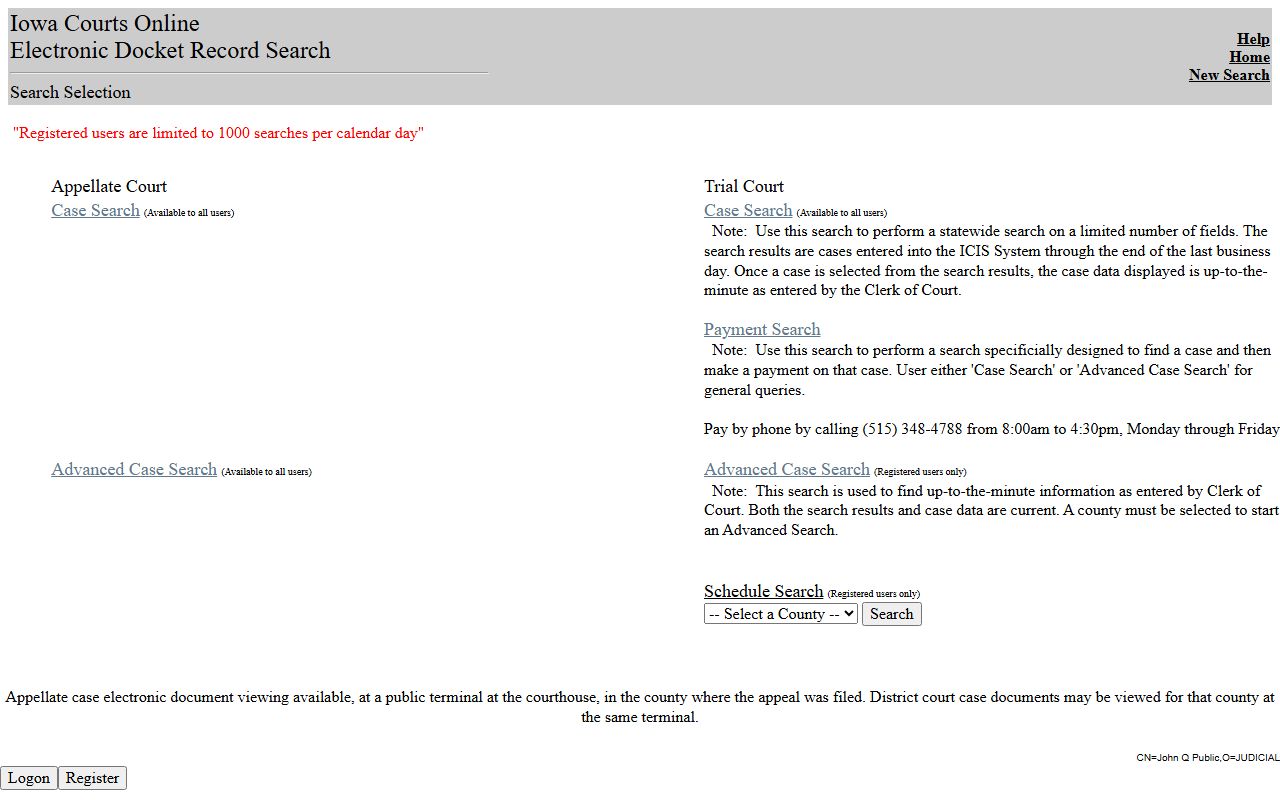
The portal view matters because Osceola County does not run a separate county-only criminal case portal for court records after arrest.
Osceola County Court Search Fields
Iowa Courts Online supports several search paths. Name search is often the first path after a jail arrest because the jail roster does not publish a court case number. A case ID search works when a citation, clerk notice, or attorney communication already gives the case number. A citation search can be useful for traffic or ticket-based criminal matters, but the official help notes that citations may take up to 14 days to post.
| Tab | Field | Type | Required | Notes |
|---|---|---|---|---|
| Name Search | Last or Firm Name | Text | At least two letters | Wildcards can help with uncertain spelling. |
| Name Search | First Name | Text | Optional | Do not enter a period after a first initial. |
| Name Search | Role | Dropdown | Optional | Can narrow to defendant or other party roles. |
| Name Search | County | Dropdown | Optional | Select Osceola to narrow local case results. |
| Name Search | Case Type | Dropdown | Optional | Criminal, civil, juvenile, small claims, traffic, or all. |
| Case ID Search | County and Case Type | Dropdowns | Yes for case ID search | Case type abbreviations include criminal and traffic categories. |
| Case ID Search | Case ID | Text or split fields | When searching by ID | Case ID is 17 characters and uses capital letters. |
| Citation Search | Citation number | Text | When using citation search | Citation or ticket records may take up to 14 days to post. |
| All public searches | reCAPTCHA | Captcha | Required | The portal uses anti-automation controls. |
Osceola County Clerk Records
The Osceola County Clerk of Court is the local court-record office when Iowa Courts Online does not supply the document or when an older record is not electronic. The clerk is on the ground floor of the Osceola County Courthouse at 300 7th Street in Sibley. Office hours are 8:00 AM-4:30 PM. The phone number is 712-754-3595, and the fax number is 712-754-2480.
Osceola County Clerk of Court
Ground floor, Osceola County Courthouse
300 7th Street
Sibley, IA 51249
712-754-3595
Hours: 8:00 AM-4:30 PM
Osceola County Attorney's Office
300 7th Street
Sibley, IA 51249
712-754-4604
County Attorney: Dawn Wilson
Charges After Osceola County Arrest
The jail roster can list booking or arrest charges in plain language. Formal court records after a jail arrest begin when a charging document is filed. In Osceola County, the County Attorney reviews law-enforcement information and decides what charges to file, amend, reduce, or dismiss. The filed court charge may not match the booking wording exactly because the prosecutor can change count, class, wording, and charge theory after review.
| Document | Usually Filed By | What It Does |
|---|---|---|
| Complaint | Law enforcement or prosecutor | Starts or supports a criminal case with an allegation and factual basis. |
| Information | County Attorney | Common Iowa charging document, often called a trial information, for many indictable offenses after prosecutor review. |
| Indictment | Grand jury | Formal accusation returned by a grand jury in cases where that route is used. |
Osceola County Charge Status
Court records after an arrest show status changes as the case moves. A charge can be pending, amended, reduced, dismissed, or resolved by plea or verdict. A disposition is the court's recorded outcome for a charge or case event. A charge is not a conviction unless the record shows a guilty plea, guilty verdict, or other conviction result. For Osceola County cases, the court docket is the better source for charge status than the weekly jail roster.
| Status | What It Means |
|---|---|
| Pending | The charge has been filed and has not reached a final court outcome. |
| Amended | The prosecutor or court record changed the charge wording, count, class, or related detail. |
| Reduced | The charge moved to a lesser offense or lower level as reflected in the court case. |
| Dismissed | The charge was removed or ended without a conviction on that charge. |
| Disposition entered | The court has recorded an outcome, such as plea, verdict, sentence, dismissal, or other final action. |
Bond After Osceola County Arrest
The Osceola County roster has a Bond line for each entry. Inspected examples included cash-only bond, C/S notations, No Bond, and N/A. The sheriff page does not define C/S or publish a detailed bond-posting instruction page, so bond status should be confirmed with the jail or court before anyone travels or pays money. If the line says No Bond, a jail payment may not release the person. A court hearing, court order, serious charge, detainer, or other hold may control release.
Iowa Code 804.21 covers initial appearance after arrest by warrant, 804.22 covers initial appearance after warrantless arrest, and chapter 811 governs pretrial and post-trial release and bail. Iowa Courts Online should be checked after charges are filed because the court record may show bond events, case schedules, and formal charge status that the jail roster does not show.
| Bond Type | How It Works |
|---|---|
| Cash bond | Money is paid directly under court rules and may be affected by case outcome and financial obligations. |
| Cash-only bond | The roster examples use this term when the amount must be posted in cash if still current. |
| Surety bond | A surety or bond company may be involved, but local requirements must be confirmed with the court or jail. |
| Own recognizance | Release based on a promise to appear, when allowed by the court. |
| No bond | The person is not releasable by posting bond at the time reflected in the record. |
Warrants and Court Records
No official active warrant search was located for Osceola County in the inspected official sources. The local access channels are the sheriff's office by phone at 712-754-2556, the sheriff's office in person at 309 6th Street in Sibley, the Clerk of Court at 300 7th Street, and Iowa Courts Online when a public case exists. A Chapter 22 public-record request may help for some warrant-related records, but active or confidential warrant material can be restricted.
The Iowa Judicial Branch restricted-documents material says criminal cases with outstanding search, seizure, or arrest warrants are confidential until the warrant is served, then public unless the court orders otherwise. Arrest warrant applications and orders are restricted to authorized justice-system users until execution, return, or initial appearance. If a warrant results in booking, the weekly roster may later list language such as Osceola County warrant or warrant-related charge wording.
Charges Versus Convictions
Court records after an arrest must be read by stage. Arrest means a person was taken into custody. A charge is an accusation filed or tracked in the court case. A conviction is a court outcome after a guilty plea, verdict, or other conviction result. Osceola County court records can show all three types of information at different times, and reading a pending charge as a conviction is a serious error.
| Point | Charge | Conviction |
|---|---|---|
| Stage | Accusation in the court case. | Final or recorded outcome after plea, verdict, or qualifying disposition. |
| Proof | Based on legal filing and probable cause standards. | Requires the court process and applicable burden of proof. |
| Can change | May be amended, reduced, added, or dismissed. | Can be appealed, corrected, or affected by later relief, but it is not just a pending allegation. |
| Where to verify | Iowa Courts Online and Clerk of Court. | Iowa Courts Online, Clerk of Court, and official disposition or sentencing entries. |
Sealed vs. Expunged Records
Iowa open-records law starts from public access, but not every court or arrest record is public forever. Juvenile cases, sealed documents, confidential case types, active warrant material, and restricted document categories may be hidden from public online view. Iowa Code chapter 901C provides expungement paths for qualifying Iowa criminal records and ties expunged records to confidentiality. Eligibility depends on the exact case and disposition, so the public docket should not be treated as legal advice.
| Point | Sealed or Restricted | Expunged |
|---|---|---|
| Public visibility | Hidden from ordinary public access in whole or part. | Treated as confidential under the applicable expungement order and statute. |
| Record existence | The record may still exist but is not public in the same way. | The record is subject to the expungement rules that apply to that case type. |
| Examples | Juvenile, sealed, outstanding-warrant, or restricted documents. | Qualifying Iowa criminal records under chapter 901C. |
| Where to ask | Osceola County Clerk of Court or the court order controlling access. | Clerk of Court, counsel, or the court file for the expungement order. |
Iowa Access Laws
Iowa Code chapter 22 is the open-records law for state and local public bodies unless an exemption applies. Iowa Code section 22.3 allows lawful supervision, copying, retrieval, and related fees. Osceola County's posted fee policy lists $18 per hour for secretarial time, $40 per hour for attorney or confidentiality review, $0.50 per page for copies, advance payment when estimated cost exceeds $10, actual technology or outside-service costs, and actual mailing cost.
For court records after a jail arrest, the court system is usually a better first stop than a Chapter 22 request because Iowa Courts Online and the Clerk of Court are built for case access. For booking records, the sheriff's office is the local record custodian. For custody notification, use VINELink Iowa or call 1-888-742-8463. VINELink does not replace the court docket, but it can help track custody changes while the case moves.
Other Custody Record Paths
Some searches start with an Osceola County arrest but end outside the county jail. If a person is sentenced to Iowa prison, the county roster is no longer the main lookup path. Use the Iowa Department of Corrections Offender Search for state prison and certain supervision records. The DOC states offender records are public under Iowa Code 904.601, but also says data is updated weekly, may change quickly, and is not warranted for accuracy or completeness.
Federal and immigration custody are separate. Use the Federal Bureau of Prisons inmate locator for federal inmates from 1982 to present. Use ICE ODLS when immigration detention is possible. No BOP facility, ICE detention facility, or state prison was found inside Osceola County official sources, and no official Osceola County app-only roster exists. For same-day local custody questions, the sheriff or jail phone remains 712-754-2556.
Important: Court, jail, DOC, BOP, ICE, and VINELink records answer different questions and should not be merged into one status.
Restricted Osceola County Court Records
Some court records after an Osceola County arrest are not available through public online search. Juvenile and other confidential case information is not available online. Trial case electronic documents may be viewed for Osceola County at the courthouse public access terminal, but the public portal does not provide every document to every user. Some fields, including schedules, judgment index, lien index, exhibit lists, bonds, and service return information, may require a paid subscription according to official Iowa Courts Online help material.
The official restricted case and document list should be used when a search result is missing or a document cannot be viewed. A missing online record can mean several things: the case has not yet posted, the citation has not yet appeared, the spelling is off, the case is older, the document is restricted, or the matter is confidential. For local help, use the Osceola County Clerk of Court rather than assuming the arrest did not produce a court record.